Tampilkan postingan dengan label Canbassador program. Tampilkan semua postingan

Sabtu, 06 Agustus 2016

Peach Frangipane Tart with Puff Pastry

Peach Frangipane Tart by Eve Fox, the Garden of Eating, copyright 2016

This lovely, rustic tart pairs the juicy sweetness of fresh peaches with the rich, nuttiness of frangipane -- all of it nestled in a flaky, buttery crust. Using puff pastry in place of a traditional tart crust makes it significantly simpler and quicker to make. Puff pastry for the win!

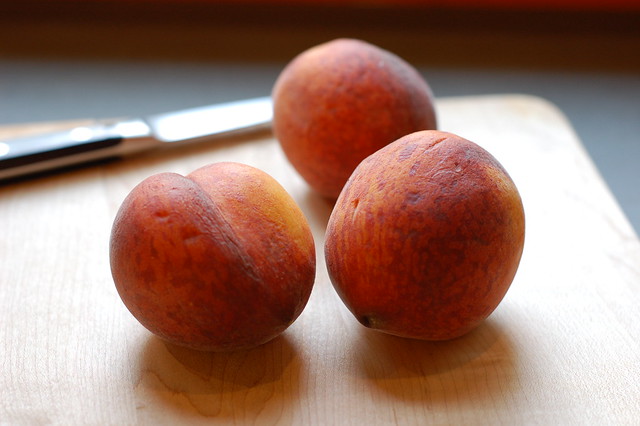
A fresh, ripe peach by Eve Fox, the Garden of Eating, copyright 2016

I was inspired by the beautiful peach frangipane tart that won first prize at this Wednesday's peach pie contest at the Woodstock Farm Festival. Thanks for the idea, Dolores!

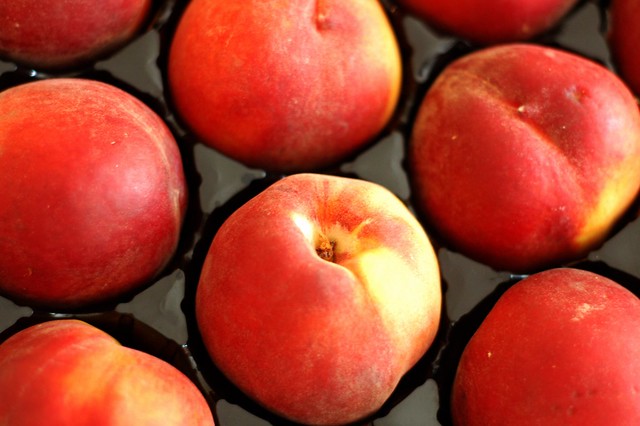
Peaches by Eve Fox, the Garden of Eating, copyright 2016

We received a big box of sweet, juicy, golden orbs in the mail on Thursday, courtesy of the Washington State Stone Fruit Growers Association's Canbassador program. They're mighty tasty. Technically, I'm supposed to make jam or chutney or somesuch with them but that doesn't mean I can't use some of them for other things...

Almond meal by Eve Fox, the Garden of Eating, copyright 2016

Frangipane is a creamy, almond-flavored paste made by mixing ground almonds with butter, sugar and egg plus a little bit of amaretto and a pinch of salt. In other words, heaven.


Mixing the frangipane by Eve Fox, the Garden of Eating, copyright 2016

While you're pre-baking the puff pastry shell, you mix up the frangipane. The puff pastry will balloon up when you bake it, so after you take it out, you give it a bit of a beat down to flatten it out but leave the edges alone so they stay puffed up to help contain everything as it bakes. Then spread the frangipane over the flattened part.

Pre-baking the puff pastry by Eve Fox, the Garden of Eating, copyright 2016

Brush a mixture of peach preserves thinned with amaretto liqueur over the frangipane, then top with sliced, fresh peaches and give it all a sprinkle of sugar and some sliced almonds (though I didn't have any sliced almonds.)

Peach Frangipane Tart by Eve Fox, the Garden of Eating, copyright 2016

Then you bake it until the peaches are golden and the frangipane has puffed up in all the nooks and crannies and gotten a little browned and bubbly. Let it cool down enough to avoid burning your tongue, then eat it!

Peach Frangipane Tart by Eve Fox, the Garden of Eating, copyright 2016

Please note: I made my tart rectangular rather than circular because it's much, much easier and also because there is no wasted pastry.

-- print recipe --
Peach Frangipane Tart With Puff Pastry
Makes one, large tart

Ingredients

* 1 lb puff pastry
* 4 just-ripe peaches
* 1/2 cup butter, at room temperature
* 1/2 cup cane sugar, plus 1 tsp extra for sprinkling
* 2/3 cup ground almonds
* 1/4 tsp sea salt
* 2 eggs
* Zest of 1 organic lemon
* 1/2 tsp almond extract
* 1/2 cup peach or apricot jam
* 2 Tbsps amaretto liqueur
* 1/4 cup flaked almonds (optional)
* All-purpose flour, for dusting

Directions

1. Preheat the oven to 385°F. Place a Silpat or other baking sheet in a large baking tray or line it with parchment paper. If your puff pastry is not already in sheet form, you'll need to roll it out on a floured surface to 1/8-inch thickness and then transfer it to the baking sheet. I just unfolded the puff pastry right on the Silpat in my baking sheet and patted it gently into the right shape. Once it's all flat and perfect, use a sharp knife to score a line about 1 inch in from the edge all the way around.

2. Bake the puff pastry in the oven for 12-15 mins until lightly puffed and golden. Remove from the oven and gently push the center down with the back of a large spoon so that you have a flat base with a raised border.

3. Meanwhile, halve and stone the peaches, then slice them thinly and let them drain. In a bowl, beat together the butter, sugar, salt, ground almonds, eggs, lemon zest, almond extract and 1 Tbsp Amaretto, if using. Spread the frangipane evenly over the pastry, leaving the border free.

4. Combine the peach or apricot jam and the remaining tablespoon Amaretto in a small saucepan. Bring to a boil, stirring to melt the jam. Boil until slightly thickened, about 30 seconds. Brush the mixture over tart filling and top with the peach slices, neatly overlapping them in circles. Sprinkle over the remaining sugar and the optional flaked almonds.

4. Bake for 30 mins, then turn the oven down to 350°F, cover the tart lightly with foil and cook for another 30-40 minutes. The frangipane should puff up between the peaches and be golden brown. Remove and cool on a wire rack, then slice and serve. Leftovers will keep for 1 day.

You might also like:


Jumat, 24 Juni 2016

Cherry Berry Fruit Leathers

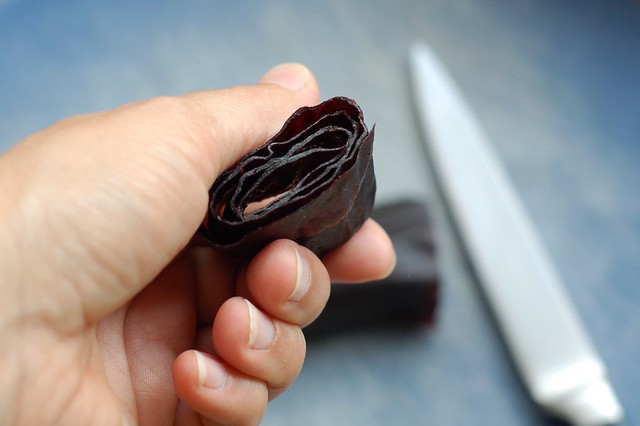
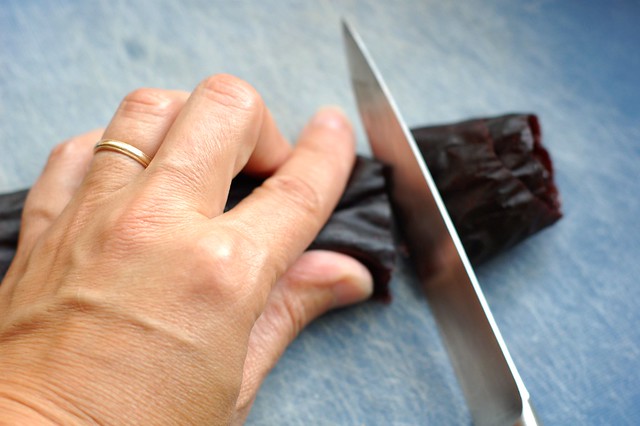
Slicing the first sheet of cherry berry fruit leather by Eve Fox, The Garden of Eating, copyright 2016

We had a strangely snowless winter here in the Hudson Valley. But the tail end caught us by surprise - a late spring storm followed by several days of frigid temps that decimated the cherry crop (and probably some others) hereabouts. So no glorious outing to pick jewel-like fruits from the trees for us this year.

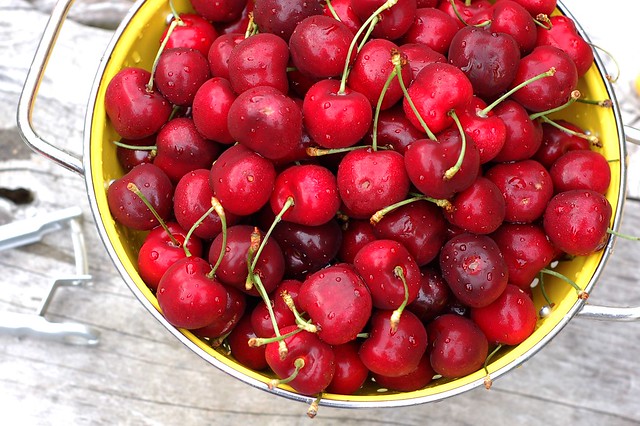
Fortunately, the Washington State Stone Fruit Growers mailed me a case of perfect sweet cherries as part of their Canbassador program earlier this month.

Sweet cherries from WA State Stone Fruit Growers Association by Eve Fox, the Garden of Eating, copyright 2016

Most of them found their way into hungry mouths, leaving little faces stained purple with their sweet juice. But we held enough aside to make a big batch of cherry berry fruit leathers, adding a bag of frozen blueberries to the colorful mix.

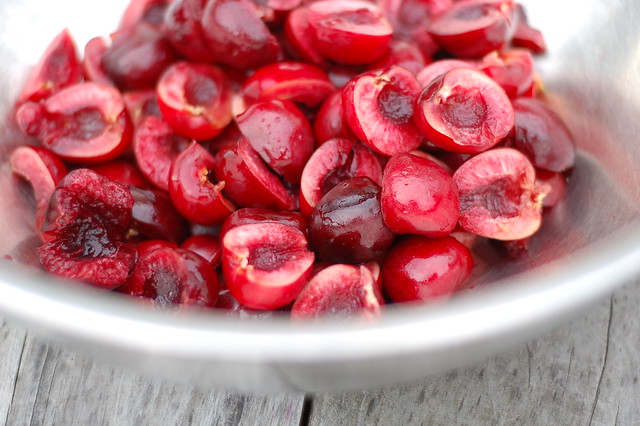
Pitted, sliced cherries by Eve Fox, the Garden of Eating, copyright 2016

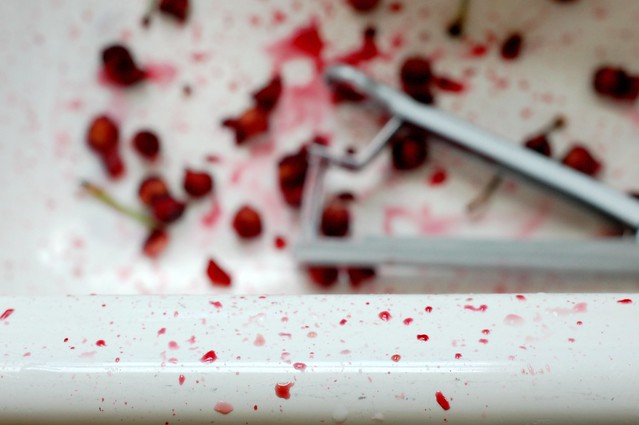
Pitting cherries is a messy affair best tackled outdoors unless you want your kitchen to look like a crime scene. It's also way more fun with a crowd to keep the talk and the pits flowing. The only tool you really need is a cherry pitter. They're a good investment if you ever plan to do anything with cherries - I got this simple, metal one for about $10 a few years ago.

Cherry pitting carnage by Eve Fox, Garden of Eating blog, copyright 2011

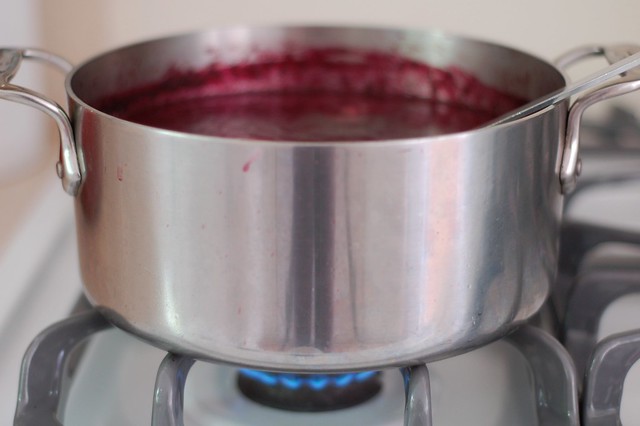
Once you've got those little suckers removed, the rest is fairly easy. Simmer the fruit with a little water until soft and then puree it until smooth, adding a little sugar or not, according to your taste and the natural sweetness of the fruit you're using. Cook the puree on low heat until it's reduced to the consistency of baby food.

Reducing the cherry berry fruit leather mixture before dehydrating by Eve Fox, The Garden of Eating, copyright 2016

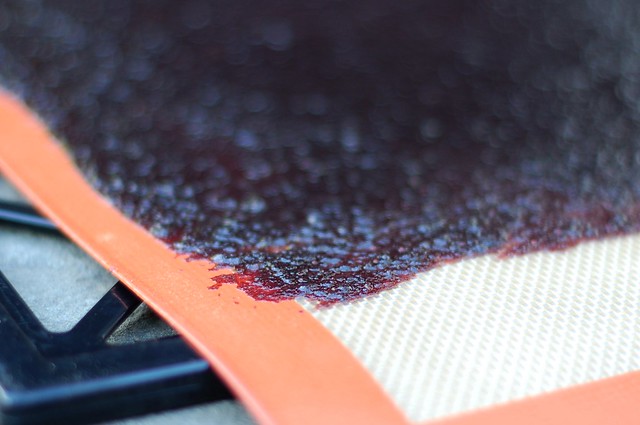
Then spread it onto a sheet of parchment paper or a Silpat and cook it on low heat for a number of hours in either the oven or a food dehydrator until it's only the tiniest bit tacky but still flexible. Our food dehydrator, the excellent Excalibur, allows us to dry foods on a larger scale without heating the house up on hot days but the oven works just fine, too.

Cherry berry fruit leather in the food dehydrator by Eve Fox, The Garden of Eating, copyright 2016

Then you let it sit until it's cool enough to handle, roll it up and slice it into whatever width strips you like.

Slicing the first sheet of cherry berry fruit leather by Eve Fox, The Garden of Eating, copyright 2016

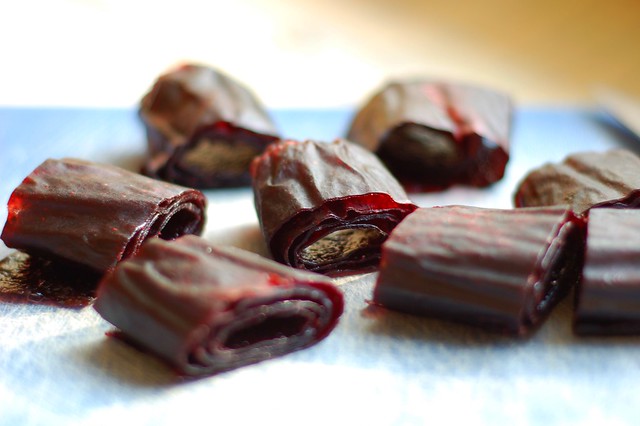
Et voila, delicious, preservative-free fruit leathers! You can store them rolled up in an airtight container at room temperature for about a month (maybe a bit longer during the cold months and a bit shorter during the warm months).

Cherry berry fruit leather by Eve Fox, The Garden of Eating, copyright 2016

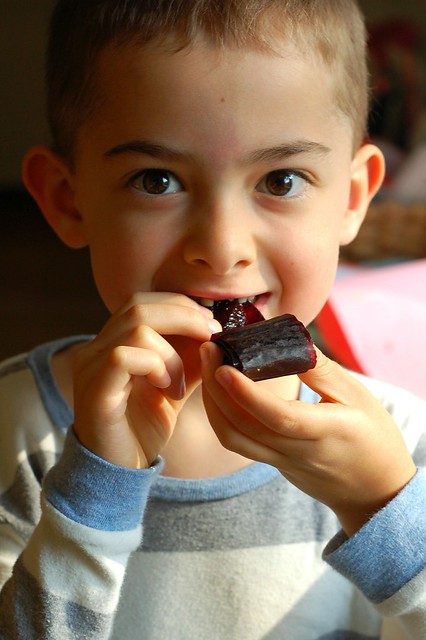
Make a big batch, they go quickly (even if you only have one front tooth)...

Will eating the first cherry berry fruit leather by Eve Fox, The Garden of Eating, copyright 2016

-- print recipe --
Cherry Berry Fruit Leather
Adapted from Put 'em Up!

Ingredients

* 4 cups sweet dark cherries, stemmed and pitted (a cherry pitter will definitely come in handy)
* 2 cups blueberries, rinsed and dried
* A large splash (roughly 1/4 cup) of water
* 1/3 cup sugar (optional)
* You will also need either unbleached parchment paper or a Silpat

Directions
1. Put the cherries, blueberries and water in a medium-sized pot (taller sides are better since you'll be blending in the pot) and bring them to a boil. Simmer until the fruit begins to break down, about 10 minutes. Puree the fruit, using an immersion blender or by pouring it into a blender and then back into the pot again.

2. If you're using the oven, preheat it to 175° F. Line a jelly-roll pan or rimmed baking sheet with unbleached parchment paper or a Silpat and set aside.

3. Add the sugar and continue to simmer the fruit puree over low heat, stirring frequently, until it thickens to the consistency of baby food - this may take 10-15 minutes.

4. Spread the sweetened, thickened puree onto the baking sheet, tilting to create an even layer about 1/4-inch thick. The edges will dry out more quickly so try to leave them a tiny bit thicker.

5. If you're using the oven, bake until just tacky to the touch which can take anywhere from 3-6 hours, depending on how juicy your puree is. If you're using a food deyhdrator, set it to 130° F and cook for between 6-12 hours, testing every hour or so until smooth to the touch with no visibly wet spots.

6. Cool to room temperature. Slide the parchment paper or Silpat onto a cutting board and peel the leather off. Then roll each sheet up and slice it into two- to three inch-wide pieces. Store, rolled up in an airtight container on the counter for up to a month.

You might also like:

Senin, 24 Agustus 2015

Nectarine (or Peach) Chutney - Sweet, Spicy & Pickled

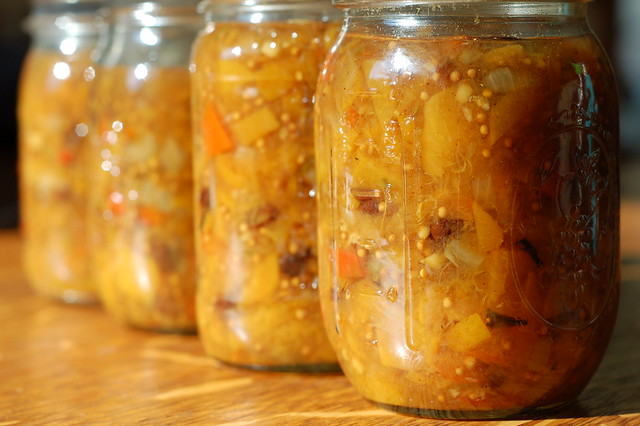
Nectarine chutney with fruit from WA State Stone Fruit Association's Canbassador program using Kevin West's recipe in Saving the Seasons by Eve Fox, The Garden of Eating, copyright 2015

Late last month, we received a case of mighty tasty peaches and nectarines from the Washington State Stone Fruit Association as part of their "Canbassador" program. As a "Canbassador", I agree to can something and write about it and, in turn, they send me cases of fresh fruit to use - a mutually beneficial relationship which kicked off with a case of sweet cherries in June.

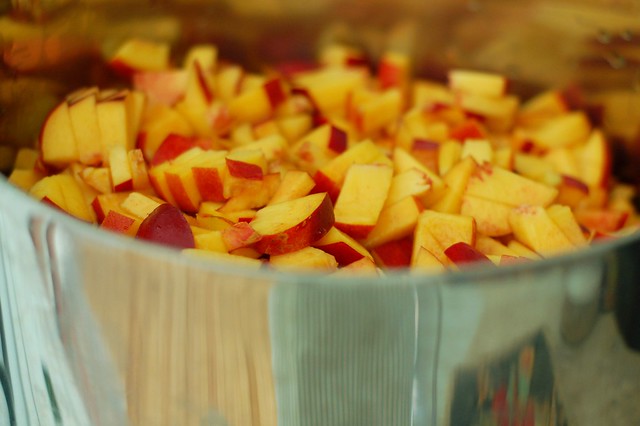
Peaches for chutney by Eve Fox, the Garden of Eating, copyright 2015

We ate quite a lot of them out of hand - in fact, our older son ate so many that I had to threaten to take away his dessert to get him to put the brakes on before he suffered any ill effects. Thus far, the power of dessert is unparalleled when it comes to "reasoning" with our children. Usually, it's the only thing that works...

I also made a delicious peach cobbler with biscuit topping and a delectable, gluten-free peach crisp (just substitute peaches for apples in this recipe) but a case contains rather a lot of fruit and it quickly became apparent that some canning was in order.

The Peaches by Eve Fox, Garden of Eating blog, copyright 2011

Chutney was our go-to choice since we use quite a lot of it in the course of the year. The combination of sweet, spicy and pickled goes so well with curries, fritters, meats and more. We've made loquat chutney, apple rhubarb chutney, sweet cherry chutney and plum chutney - all delicious. But this was our first time using nectarines and the results were very fine.

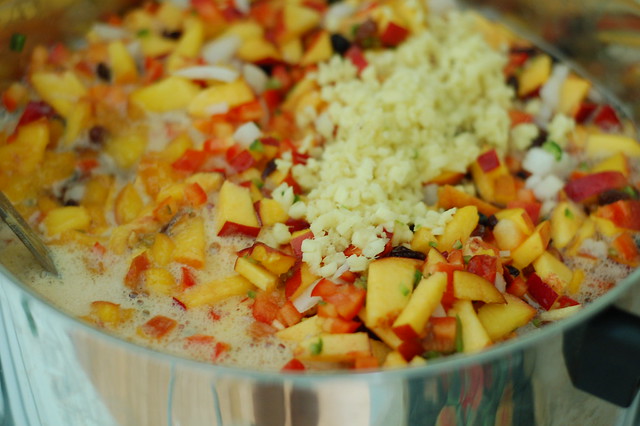
Nectarine chutney by Eve Fox, the Garden of Eating, copyright 2015

How can you really go wrong with perfect, sweet, ripe nectarines, fresh ginger, garlic, jalapenoes, bell pepper, onion and peppercorns plus plenty of vinegar and sugar to turn it into something that is both zingy and also shelf-stable. This recipe also calls for a few other spices and some Darjeeling tea which struck me as a novel way to add even more flavor.

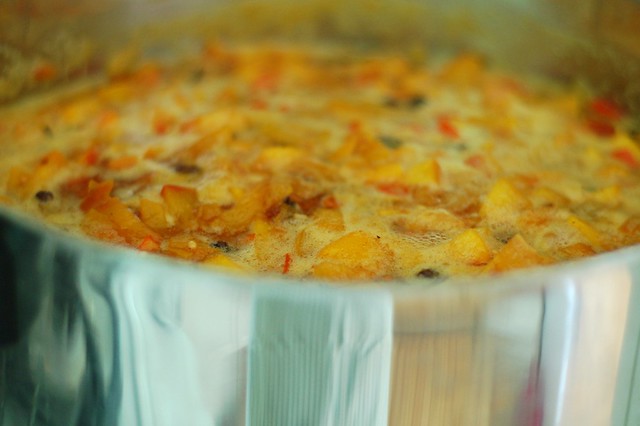
Nectarine chutney by Eve Fox, the Garden of Eating, copyright 2015

I have to thank my college friend, Lexy who lives in New York and works in publishing for sending me a copy of Kevin West's beautifully written, wonderfully thorough book, Saving the Season: A Cook's Guide to Home Canning, Pickling, and Preserving from which this recipe hails.
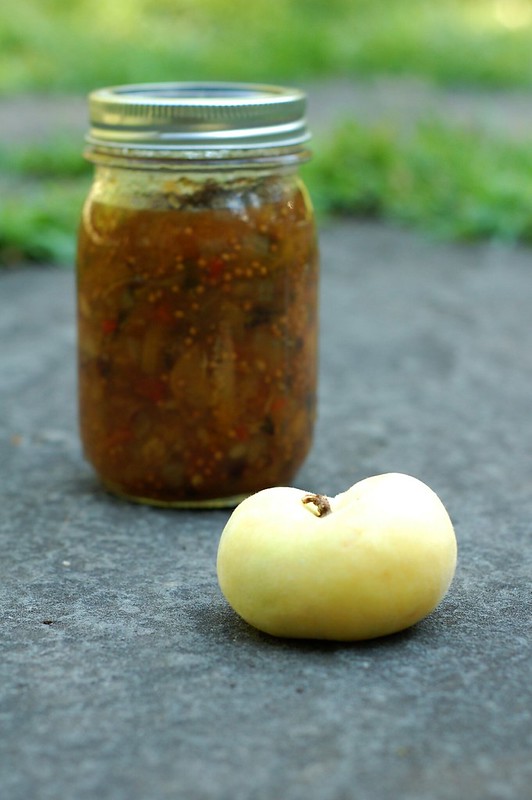
Nectarine chutney by Eve Fox, the Garden of Eating, copyright 2015

It's a cookbook that reads more like a memoir and is nicely rooted in place - in his case, Greenvalley, CA where he lived when he wrote it. It's joined the ranks of my favorite canning and preserving cookbooks, along with Food in Jars by Marisa McLellan and Put 'em Up!by Sherri Brooks Vinton.


If you've never canned anything before or just need a little refresher, check out my Canning 101 post before you dive in.

Nectarine chutney with fruit from WA State Stone Fruit Association's Canbassador program using Kevin West's recipe in Saving the Seasons by Eve Fox, The Garden of Eating, copyright 2015

-- print recipe --Nectarine or Peach Chutney
From Kevin West's delightful book, Saving the Season
Makes 4 pints

Ingredients

* 5 pounds yellow peaches or nectarines, peeled and cut into 1/2-inch cubes
* 3 cups organic or turbinado sugar
* 2 cups apple-cider vinegar
* 3/4 cup raisins
* 1 cup chopped Vidalia onion
* 1 sweet banana pepper or 1/2 yellow bell pepper, diced
* 2 or 3 fresh green jalapeños, diced, or adjust to taste
* 2 cloves garlic, minced
* 2 tablespoons grated fresh ginger root
* 2 teaspoons freshly grated turmeric, or 1/2 teaspoon ground
* 4 tablespoons mustard seeds
* 1 teaspoon garam masala (a ground spice mixture containing pepper, cloves, cinnamon, cardamom, coriander, nutmeg, cumin, and star anise)
* 2 teaspoons Darjeeling tea (or 4 tea bags)

Directions

1. Combine all the ingredients in a deep pot and bring to a boil, stirring a few times. Lower the heat to a simmer and reduce the mixture for up to an hour, until all the excess liquid has boiled away and what remains is thick and jammy. Taste it and adjust the seasonings to your liking. I am wimpy about spice so I tend to err on the mild side of things but you may like it hot in which case, you may want to add more chilis.

2. Ladle the hot chutney into four prepared pint jars, leaving 1/4" headspace. Wipe the rims with a damp, clean cloth, top with the jar lids, add the rings and turn until tight but do not overtighten then process in a boiling-water bath for 10 minutes. For best flavor, let the chutney cure for a month before you eat it.

You might also like:


For more delicious recipes, gardening ideas, foraging tips, and food-related inspiration "like" the Garden of Eating on Facebook, or follow me on Twitter and Pinterest.